TPN: Enterprise UC-over-IP Powered by 10G SDVoE
Bring USB-C collaboration, uncompromised 4K60 video, USB and KVM routing, and centralized system management onto one scalable 10G AV-over-IP platform.
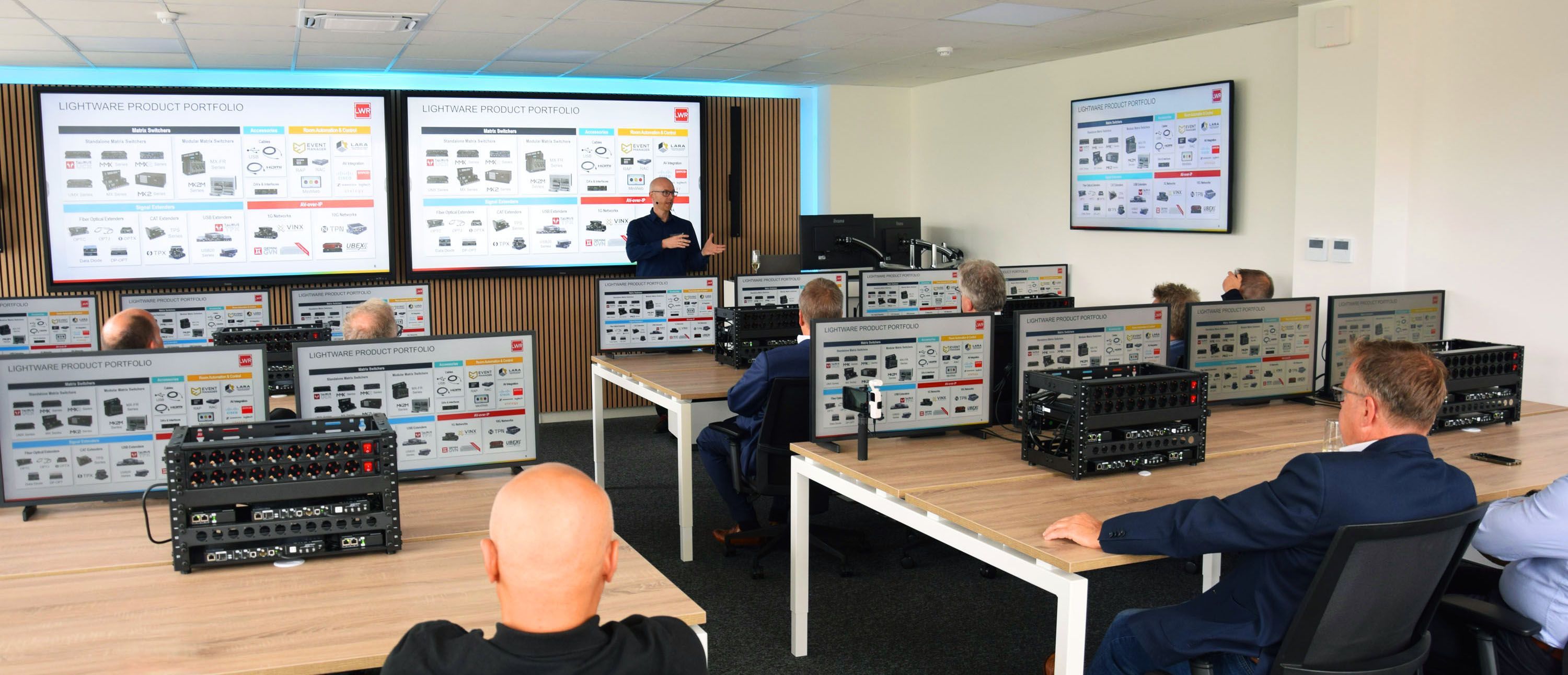
As AV-over-IP systems grow, integrators must manage more endpoints, longer distances, multiple signal types and increasingly complex network infrastructures without compromising image quality, switching performance or system reliability. TPN is Lightware’s answer: a scalable 10G SDVoE-based ecosystem that brings USB-C, HDMI, USB, copper and fiber connectivity under one centralized management platform.
As AV-over-IP systems grow, so does their complexity. TPN makes them easier to design, manage and scale, bringing USB-C, HDMI, USB, copper and fiber together on one centrally managed 10G platform.
TPN – 10G SDVoE System Key Features
Uncompromised 4K60 4:4:4
Visually lossless video for critical applications
Frame-accurate synchronization
Genlock for perfectly synchronized multi-display systems
Seamless source switching
Fastswitch mode on selected SR endpoints
USB-C and USB over IP
Connect hosts and share peripherals across the network
Copper and fiber connectivity
Scale across rooms, buildings and longer distances
Centralized system management
Discover, configure, route and monitor through the MMU
Find the Right TPN Solution for Your Project
Start with your application. Choose the endpoint, connectivity and management solution that best fits your system.
Select What You Need
Choose Any to include both options.
Centralized System Management
Managing every endpoint separately takes time and makes complex AV-over-IP systems harder to operate. Lightware’s Matrix Management Unit brings discovery, configuration, routing and monitoring into one intuitive interface.
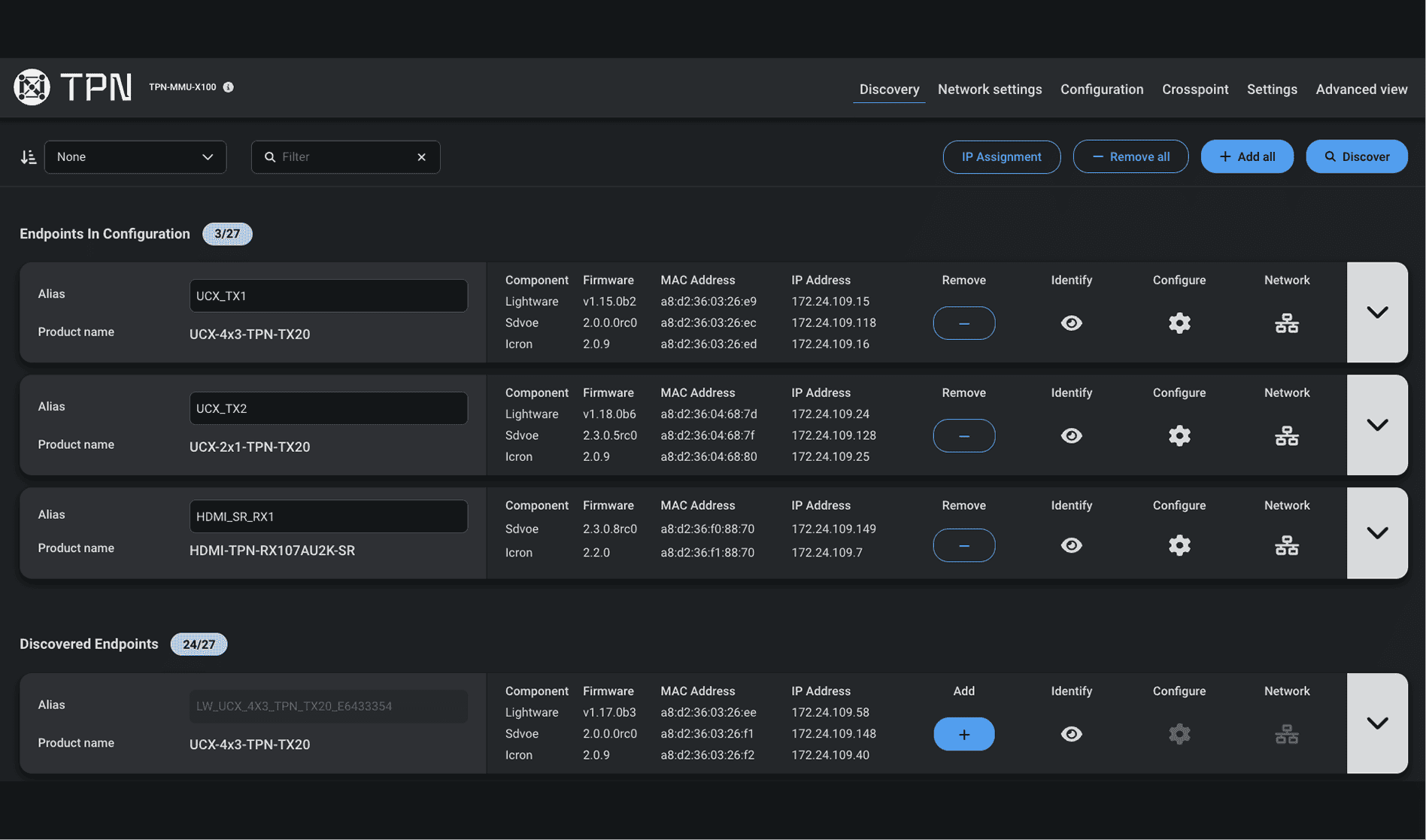
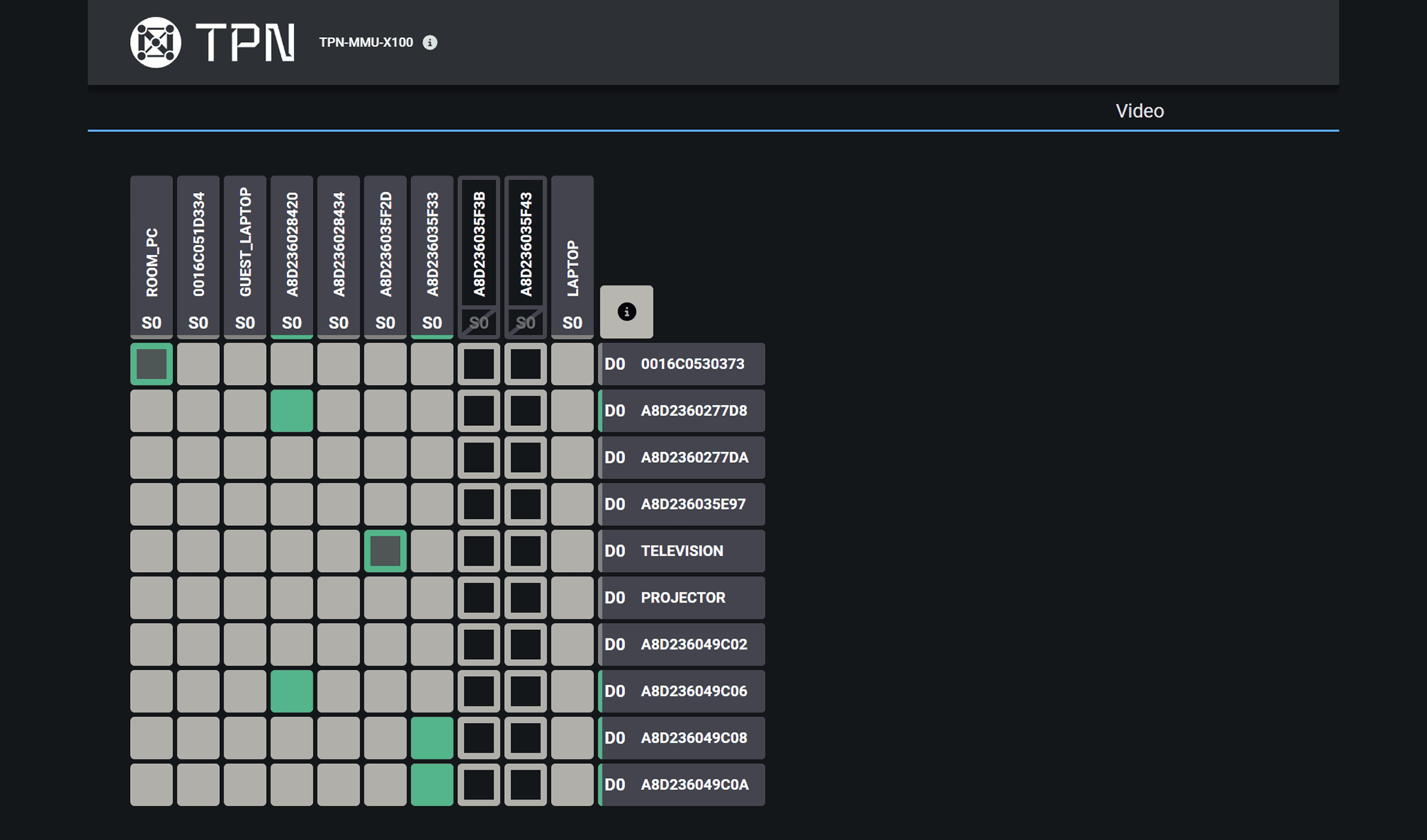
MMU automatically discovers TPN and OPTN devices across your 10G SDVoE network and builds an interactive topology map so you can see every transmitter, receiver and switch instantly. Device details (IP, MAC, alias, firmware version and status) are presented centrally, making inventory, troubleshooting and commissioning far faster than manual discovery or per-device scans.
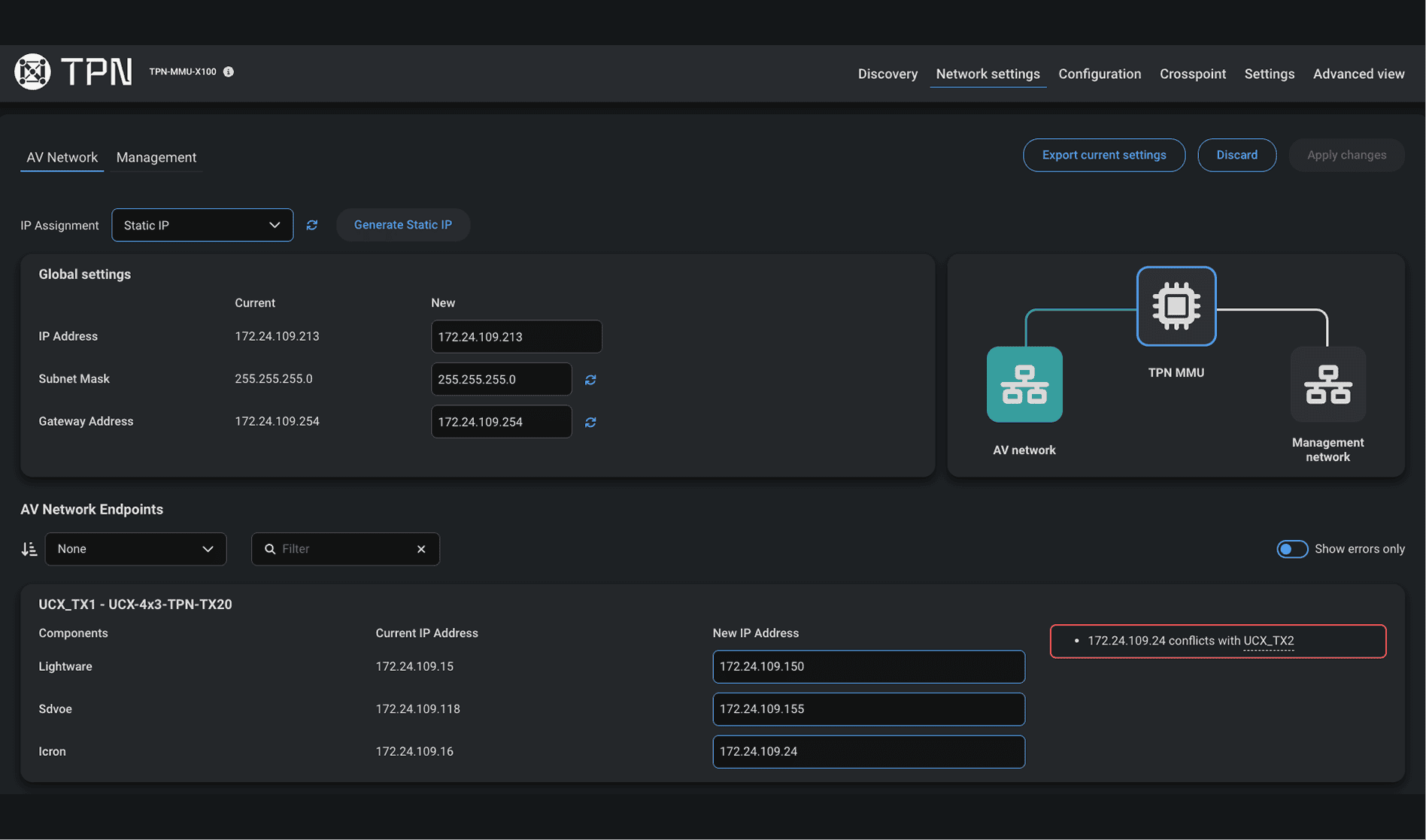
Configure network, video, and serial settings from a dedicated MMU interface designed for fast, error-free setup. The system is built around clear separation between AV and Management networks, improving security, stability, and predictability in complex deployments. Easily switch between DHCP and static IP modes with built-in validation for IP conflicts and subnet mismatches. Centralized network controls and device-level settings ensure consistent configuration across AV and Management paths, reducing setup errors and enabling reliable, long-term operation.
Control routing, monitor system health and manage USB workflows from a single MMU interface with read-only operator views and full API access for automation. The MMU exposes LW3 and SDVoE APIs for control-system integration, provides real-time diagnostics and logs, and ensures changes propagate instantly while maintaining predictable SDVoE performance across the deployment.
Scalable Endpoint Management
Manage up to 20 or 100 endpoints with the X20 and X100 MMU models
Automatic Endpoint Discovery
Automatically discover supported TPN and OPTN endpoints and view their status, identity and network information from one interface.
Faster System Configuration
Configure and name multiple endpoints centrally, reducing repetitive setup work and the risk of inconsistent settings.
Intelligent Network Setup
Manage DHCP and static IP configurations with built-in validation for address conflicts and subnet mismatches.
Centralized Video Routing
Route video between transmitters and receivers through an intuitive virtual matrix interface.
Detailed Endpoint Control
Configure scaler settings, RS-232 parameters and device-level functions without accessing each endpoint separately.
Separate AV and Management Networks
Keep high-bandwidth AV traffic separate from corporate management access for more secure and predictable operation.
Available Control Units and Switcher
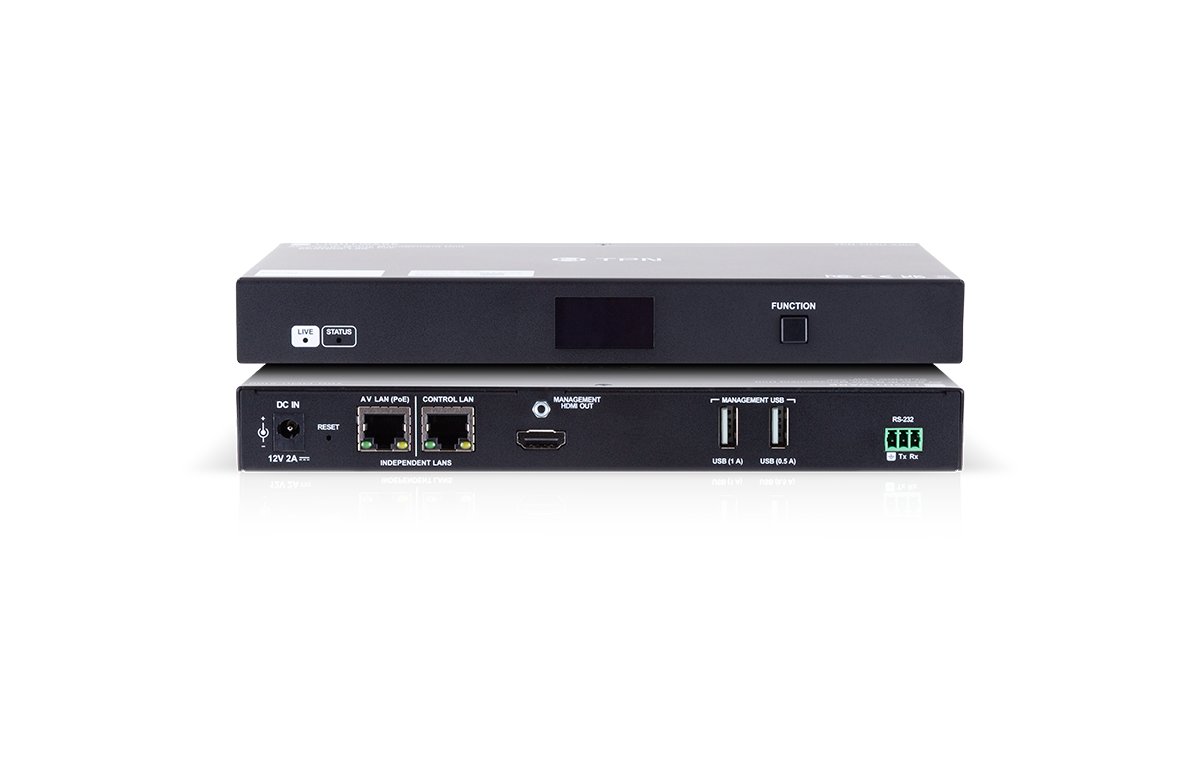


4 products
Campus Multibuilding Hybrid Learning
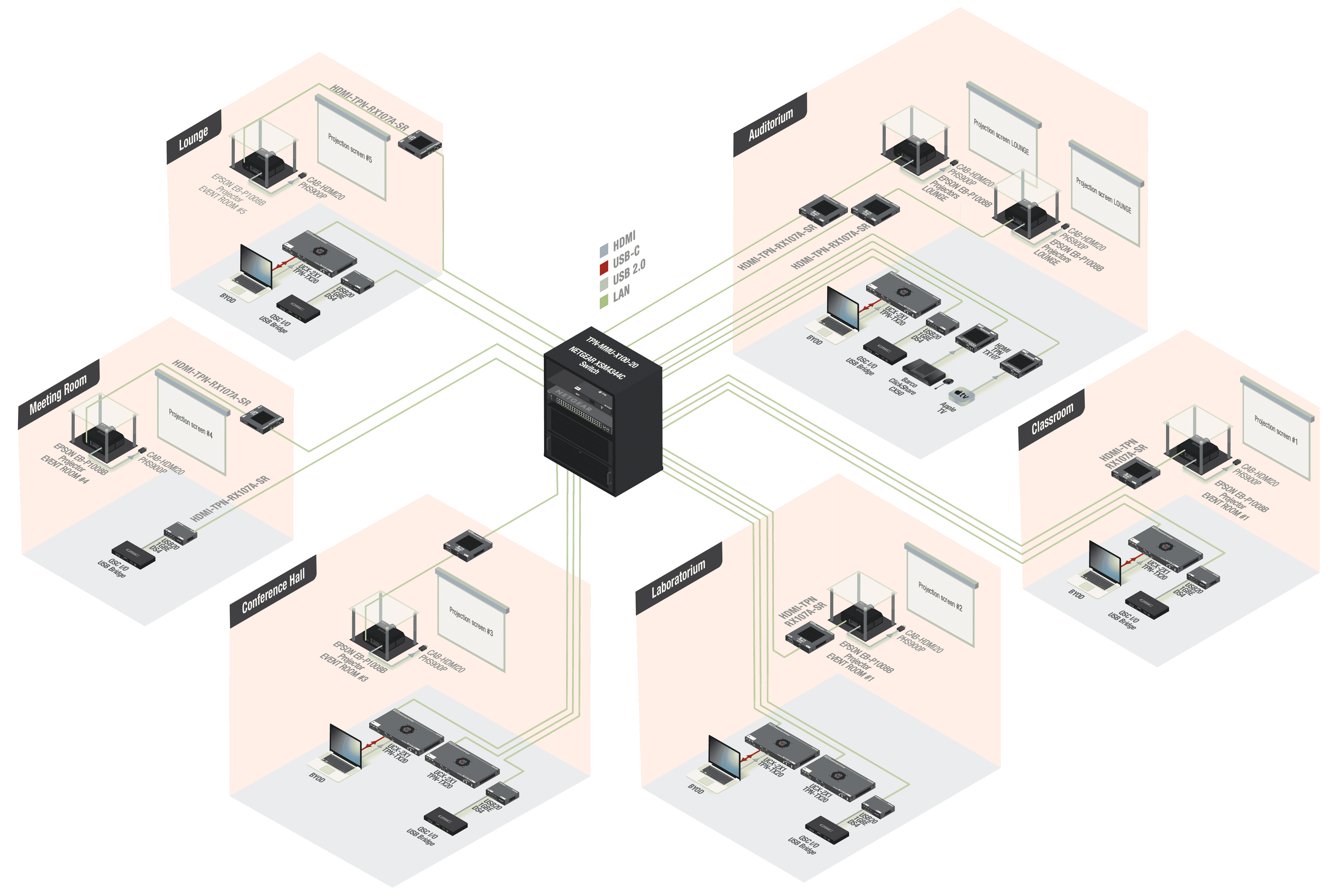
Distribute video, audio and USB signals across classrooms, meeting rooms, laboratories and auditoriums through one centrally managed 10G network. TPN provides copper connectivity within rooms, while OPTN extends signals over fiber between distant areas or buildings:
- Any source can be shared across multiple rooms.
- USB-C laptop connectivity and BYOM workflows.
- Networked sharing of cameras and USB peripherals.
- TPN copper connectivity within rooms and buildings.
- OPTN fiber connectivity over longer distances and between buildings.
- Centralized routing, configuration and monitoring through the MMU.
- Easy expansion with additional rooms and endpoints.
What Integrators Get with Lightware's TPN MMU
From the typical challenges of IT / AV integrators to how the MMU solves them.
In SDVoE-based systems, endpoints are often configured and monitored individually, making it difficult to maintain a clear overview of devices, roles, and system structure, especially as the system scales.
The MMU automatically discovers TPN and OPTN endpoints and presents them in a single structured interface, providing clear, real-time visibility into devices, roles, and system topology, without duplicating or replacing endpoint-level configuration data.
Commissioning requires accessing and configuring each endpoint separately, increasing setup time and the risk of inconsistent system behavior.
The MMU streamlines configuration workflows across multiple endpoints, helping ensure consistent settings and significantly faster system commissioning.
Video routing often relies on additional controllers, external control systems, or custom scripting, adding complexity, cost, and integration effort.
With integrated SDVoE video crosspoint control, the MMU turns a standard 10G network into a virtual matrix, with no additional hardware or custom control logic required.
After handover, day-to-day operation is often unclear for IT teams or end users, leading to frequent support calls and change requests.
The MMU clearly separates commissioning and operational workflows, enabling reliable switching, preset recall, and system control through a clean, purpose-built interface.
Limited network awareness and inconsistent system structure can create friction between AV deployments and enterprise IT environments.
Through structured discovery, network-aware configuration, and transparent system visibility, the MMU enables AV-over-IP systems to integrate naturally into IT-managed networks.
Validated 10G Networking
TPN systems are built on SDVoE technology, where network quality directly defines AV performance. Together with NETGEAR, we offer pre-validated 10G AV Line switching solutions for TPN environments. Tested interoperability, stable multicast handling, and deterministic real-time performance let TPN operate as a reliable virtual matrix over standard 10G infrastructure, reducing deployment risk and speeding up commissioning.
Related Training Materials
AV-over-IP System Basics